The Most Important Music Lesson of My Life
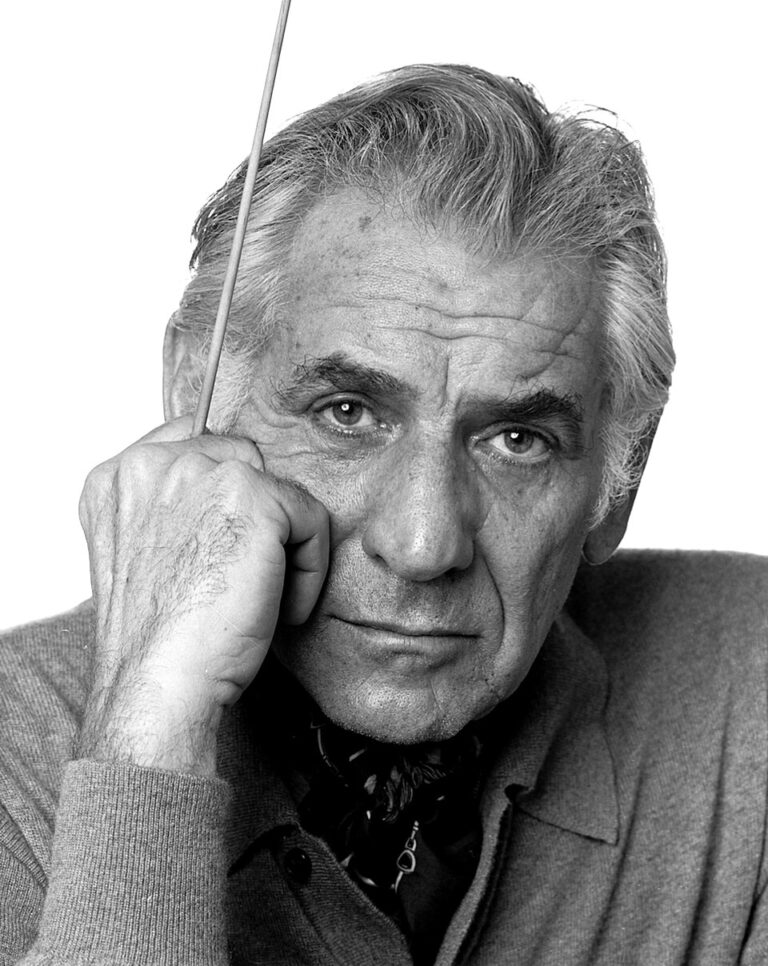
Jack Mitchell (1925–2013). Used under the Creative Commons Attribution-ShareAlike 4.0 International (CC BY-SA 4.0) License. No changes were made. https://creativecommons.org/licenses/by-sa/4.0/
From the Conductor's Notebook
In the summer of 1983, I was accepted into the conducting program at Tanglewood, the summer home of the Boston Symphony Orchestra and the most famous summer school for mentoring conductors in the United States. I wanted to go there for one reason: Leonard Bernstein came to Tanglewood every summer for part of the season, and his association with the institution was legendary.
I arrived full of excitement.
The head of the student program at the time was Gunther Schuller, whom I knew primarily as a composer. He gave the opening address for the summer, and the theme was simple: “Stick to the score.”
He talked about eliminating the word interpretation and replacing it with the word realization. The idea was straightforward: play only what is written in the score—nothing more. Let the music speak for itself. Don’t “interpret” anything. (This philosophy later became the basis of his 1997 book, The Compleat Conductor.)
During the first three weeks at Tanglewood, that message was reinforced constantly. If it wasn’t in the score, don’t do it.
In my view, it became excessive. You couldn’t even make a slight ritardando at the end of a movement unless it was specifically written. The same applied to dynamics, rubato, and even metronome markings. Joseph Silverstein, the Boston Symphony’s concertmaster, was expected to reinforce this philosophy. André Previn did as well. Gustav Meier, the conducting teacher at Tanglewood, also emphasized it. Virtually everyone was pushing the same approach.
Then, three weeks later, Leonard Bernstein arrived.
Everything changed.
Bernstein didn’t preach this philosophy. He simply taught the way he always had.
At the time, we were studying Brahms’ Fourth Symphony. During one conducting class, with Bernstein sitting in the room, we listened to his brand-new recording with the Vienna Philharmonic.
Afterward, I finally worked up the courage to ask him a question.
I said, in essence:
“In the last movement, during the tremolo passage in the strings, you speed up. It feels right. It feels natural. But everyone here keeps telling us to stick to the score. The score doesn’t say to accelerate. So why is it okay?”
His answer changed my life.
He replied (again, paraphrased):
“But it is in the score. It doesn’t say accelerando or più mosso, but it’s there. Why is it that you young conductors rely only on words and metronome markings while ignoring all the other information in the score? The notes, the rhythms, the harmonies, and the physical feeling of the instrument while playing those notes—all of that is in the score, too. Yes, you should stick to the score, but you must stick to all of the score. Use all the information the composer gave you.”
With that answer, he took a key and unlocked the ball and chain from my feet.
I was released.
For life.
His words taught me that our responsibility is still to bring the composer’s intentions to life as faithfully as we can. But achieving that requires more than a literal reproduction of what appears on the page.
The score contains far more than printed instructions. It contains musical energy, emotional direction, harmonic tension, rhythmic momentum, and the physical reality of making music.
Bringing a composer’s work to life by using all of the information contained in the score is what I strive to do in every performance.
And I have Leonard Bernstein to thank for that.